
For many years now, I’ve heard the same concern from ServiceNow partners:
“We can’t find enough talent.”
While there is certainly truth to that statement, I believe it obscures a larger issue.
We are not effectively managing our bench and finding the right balance between our core team (inelastic) and more elastic staffing options.
A Simple Utilization Exercise
Let’s start with a few assumptions:
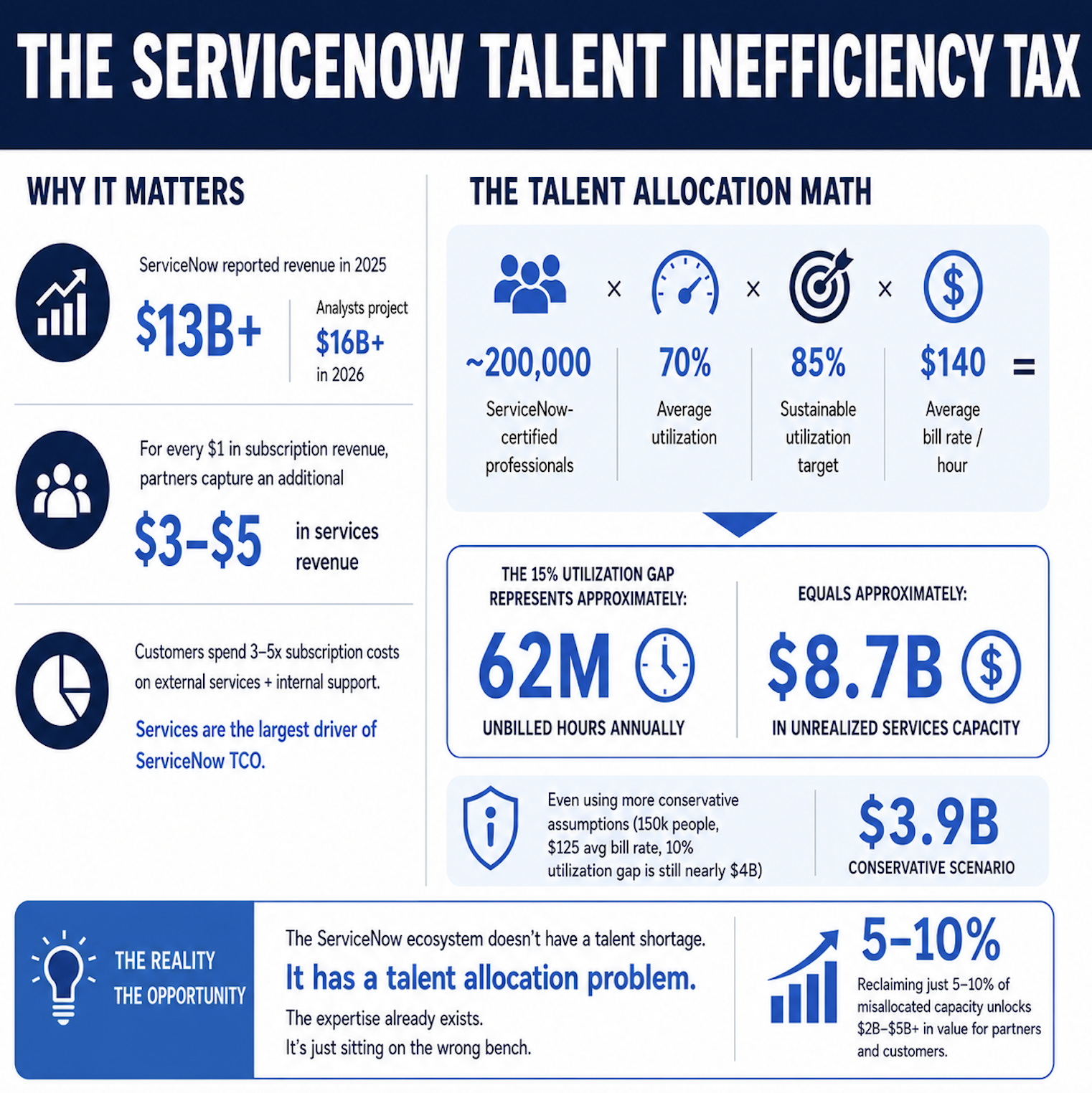
- Approximately 200,000 ServiceNow-certified professionals worldwide
- Average bill rate of $140 per hour
- Average billable utilization of 70%
- Sustainable utilization target of 85%
The difference between 70% and 85% utilization is 15%.
Assuming 2,080 available work hours per year, the ecosystem collectively represents:
200,000 professionals × 2,080 hours = 416 million available hours annually
A 15% utilization gap equates to:
416 million × 15% = 62.4 million hours
At an average bill rate of $140 per hour, that represents:
62.4 million hours × $140 = $8.7 billion annually
In other words, nearly $9 billion of services capacity may exist today but never gets monetized.
Let’s Be More Conservative
Whenever large numbers are presented, skepticism is healthy.
Not every certified professional is directly billable. Some are managers, executives, trainers, architects, sales engineers, and practice leaders.
So let’s reduce the assumptions:
- 150,000 billable professionals
- Average bill rate of $120 per hour
- Utilization gap of only 10%
The result is still approximately:
31.2 million hours of unrealized capacity
Or:
$3.7 billion annually
Whether you use aggressive assumptions or conservative ones, the conclusion remains the same:
The economic impact is measured in billions, not millions.
Why Utilization Is So Difficult in ServiceNow
The challenge isn’t poor management.
It’s the nature of the ServiceNow ecosystem itself.
Partners must support:
- More than 40 product families
- Multiple industries
- Multiple geographies
- Rapid product evolution
- Highly specialized skill sets
- AI as a disruptive force across all aspects of delivery and support
A partner may need a telecommunications CRM architect for six weeks.
Or a Manufacturing FSM expert for a three-month engagement.
Or an AI Agent specialist for a strategic workshop.
Hiring full-time employees for every possible demand scenario is impossible.
As a result, partners oscillate between two costly conditions:
Underutilization
Resources sit on the bench waiting for the next project.
Overutilization
Critical experts become overloaded, leading to burnout, delivery risk, quality issues, and employee attrition.
Both outcomes destroy value.
The Cost Is Bigger Than Lost Revenue
The utilization gap only measures unrealized billable capacity.
It does not account for:
- Delayed project starts
- Missed opportunities
- Reduced customer satisfaction
- Employee burnout
- Increased turnover
- Excessive bench carrying costs
- Revenue opportunities declined due to staffing limitations
The true cost is almost certainly much larger.
The Ecosystem Already Has Much of the Talent It Needs
This is the most important takeaway.
The conversation often centers on how to create more talent.
But what if a meaningful portion of the solution is simply making existing talent more accessible?
Every day across the ecosystem:
- One partner has excess capacity.
- Another partner has an urgent skills gap.
Yet there is no efficient mechanism for discovering and engaging one another at scale.
The result is idle capacity on one side and delivery risk on the other.
What If We Could Recover Just 10%?
Even if better partner-to-partner collaboration recovered only 10% of the estimated utilization gap, the ecosystem could unlock hundreds of millions of dollars in additional annual services capacity.
Without hiring additional consultants.
Without increasing burnout.
Without creating additional delivery risk.
Simply by improving how talent moves between partners.
That’s a conversation worth having.
Because the future of ecosystem growth may depend less on finding more people and more on making better use of the people we already have.